
Want more wrestling news, rumors, and results? Be sure to visit PWInsider.com and PWInsiderXtra.com.


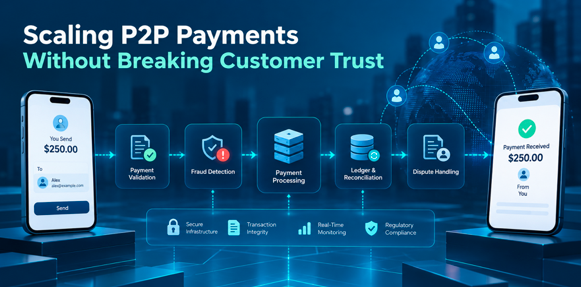
A peer-to-peer payment MVP can prove that people want the product. A sender selects a recipient, enters an amount, confirms the transfer, and sees a status on the screen. That flow may serve an early launch with a small user base and limited transaction volume.
Growth changes the engineering problem.
More users create more transfers, payment states, failed requests, fraud attempts, disputes, notifications, and reconciliation records. A transfer shown as successful in the application must match what happened across the internal ledger, payment provider, banking partner, and recipient account.
For a P2P platform, a mismatch affects customer trust. Users expect the balance, recipient, transaction status, and transfer history shown in the app to reflect what happened to their money.
Scaling beyond the MVP requires an architecture that treats transaction accuracy, payment records, fraud controls, and failure recovery as parts of the product rather than additions for a later stage.
A Guide to building P2P payment apps needs to cover more than the send-money interface. The payment lifecycle begins before a user taps “Send” and continues after the application displays a status.
Payment state is one concern. A transfer can pass through stages such as created, authorized, submitted, processed, failed, returned, or completed. The system needs one source of truth for those states so a network interruption or provider response does not create conflicting information.
Duplicate transactions create another risk. A user may tap the payment button twice when the screen appears frozen. A mobile device may retry a request after losing its connection. The backend needs a unique reference for each payment request so a retry does not create another transfer.
The ledger needs the same attention. A ledger is the system record of money entering, leaving, or moving between accounts. It should capture transfers, balances, fees, returns, and other financial events. When records disagree, operations teams need enough information to trace the transaction.
Fraud controls become part of the payment experience as volume grows. Account takeover, stolen credentials, unusual transfer amounts, new recipients, and changes in device use can create risk signals. The system needs a defined response when a transfer meets a risk condition.
Startups evaluating Mobile app development services should assess whether an engineering team can connect the customer interface with payment processing, ledger design, security controls, fraud detection, and transaction recovery.
Moving a payment MVP into a growth stage can require mobile engineering, backend systems, cloud infrastructure, payment integrations, security, and data architecture. The following US-based companies provide software engineering capabilities that can support parts of this technology stack.
GeekyAnts is an AI-Powered Digital Product Engineering & Consulting Company. Its fintech capabilities span mobile applications, digital banking, payments and wallets, financial integrations, cloud systems, security, and product engineering. Its payment work covers transaction flows, payment gateway integrations, digital wallets, authentication, fraud controls, and financial product interfaces. This range can support startups where the customer application, transaction services, financial records, payment integrations, and internal workflows need to function within one product architecture.
Clutch rating: 4.9/5 (120 reviews)
Address: GeekyAnts Inc, 315 Montgomery Street, 9th and 10th floors, San Francisco, CA, 94104, USA.
Phone: +1 845 534 6825, Email: info@geekyants.com, Website: www.geekyants.com/en-us
Clavax is a US-based software development company with work across mobile applications, custom software, cloud systems, analytics, and digital products. Its engineering scope can support fintech teams that need customer applications connected with backend services, databases, dashboards, or third-party platforms. For a P2P payment engagement, founders should examine project evidence related to payment rails, ledger systems, financial data controls, reconciliation, transaction recovery, and security before deciding whether its experience matches the requirements of the platform.
Clutch rating: 4.5 (18 reviews)
Address: 2033 Gateway Place, STE 632, San Jose, CA 95110, USA.
Phone: +1 844 425 2829
Agiliway has its head office in Austin and provides custom software engineering, mobile development, cloud services, data analytics, AI, and technology consulting. These capabilities can support fintech startups that need application engineering alongside backend processing, data systems, and cloud infrastructure. For a P2P transfer project, teams should assess project experience involving payment integrations, transaction records, authentication, financial controls, testing, and failure recovery. Those areas affect whether the customer-facing application remains consistent with the systems responsible for processing money movement.
Clutch rating: 4.5 (16 reviews)
Address: 500 E 4th Street, Suite 114, Austin, TX 78701, USA.
Phone: +1 888 218 0246
Taction Software is a US software company with capabilities across custom software, mobile applications, data engineering, AI, and system integration. Its engineering scope can support products that connect customer applications with databases, APIs, third-party services, and operational systems. For a P2P platform, founders should confirm project experience with payment processing, financial ledgers, fraud controls, reconciliation, dispute workflows, and applicable financial requirements. This assessment helps establish whether the team has the payment-specific experience required beyond general application engineering.
Clutch rating: 4.6 (14 reviews)
Address: 1016 West Jackson Boulevard, Chicago, IL 60607, USA.
Phone: +1 302 219 0001
Stride Consulting is a New York software engineering company that works across custom applications, modernization, data systems, and engineering programs. Its project history includes payment integrations, data storage, migration, testing, and work within existing product teams. This profile can fit fintech startups with an established application that needs engineering support as architecture requirements expand. For P2P systems, founders should validate experience with transaction processing, financial ledgers, payment-state management, fraud controls, and reconciliation before defining the scope of an engagement.
Clutch rating: 4.5 (4 reviews)
Address: 601 West 26th Street, Suite 357, New York, NY 10001, USA.
Phone: +1 212 634 7240
A P2P architecture starts with a defined transaction lifecycle. The backend should record whether a payment has been initiated, accepted for processing, completed, rejected, returned, or reversed. The mobile interface should display a status based on that record rather than assume that a submitted request means money moved.
The ledger provides another source of truth. Payment-provider records and internal ledger entries need identifiers that allow engineering and operations teams to trace the same transfer across systems. This connection supports reconciliation, the process of checking that financial records from different systems agree.
The architecture also needs protection against duplicate instructions. Each payment request can carry a unique identifier. If a device sends the same request again, the backend can recognize it instead of processing another transfer.
Fraud controls should sit at points where the platform can act before funds leave the sender's control. Signals can include account access changes, new devices, unusual transaction values, recipient changes, and transfer patterns. A risk decision can then determine whether the transaction proceeds, requires another check, or enters review.
Payment teams can spend an MVP phase designing the successful path. Scale exposes the paths where something goes wrong.
A transfer may fail before submission, receive a rejection from a payment provider, remain in an uncertain state, or require a return. Each state needs a defined system response and a clear message for the customer.
Disputes create another requirement. US P2P products can fall within electronic fund transfer rules based on the account and transaction involved. Product and compliance teams need to determine which requirements apply to their service and translate them into workflows for notices, records, investigations, and error resolution.
The architecture should preserve information that supports those workflows. Records may include authentication events, transfer instructions, payment states, account activity, support actions, and investigation decisions.
Trust depends on consistency between what the system records and what the customer sees. An accurate balance, traceable history, clear transaction state, and defined recovery path give users information when a transfer does not follow the expected path.
Software can handle repeatable payment work such as transaction-state updates, duplicate-request checks, reconciliation records, fraud signals, notifications, and routing. These functions reduce the amount of information that operations teams need to assemble by hand.
Human review still has a role when context determines the decision. A fraud signal may require an analyst to examine account history. A dispute may require evidence from several systems. A failed transfer may need support intervention when payment-provider records and internal records disagree.
The architecture should support that division. Software manages transaction volume and preserves evidence. People handle cases that require investigation, judgment, or communication with the customer.
That boundary matters for trust. Scaling a P2P platform does not mean removing people from every payment process. It means using software for repeatable work so teams can focus on exceptions where a person needs to understand what happened.
A P2P payment MVP proves that users can move money through an application. Scaling that product creates a different engineering challenge because each transfer carries financial, security, operational, and customer-support consequences.
A growth-stage architecture needs defined payment states, reliable ledger records, duplicate-transfer protection, fraud controls, reconciliation, dispute workflows, and recovery paths. The mobile interface must represent those backend records without creating false certainty about whether money moved.
Customer trust depends on that connection between the interface and the financial systems behind it. Users need accurate information when a transfer succeeds and when something goes wrong. Building transaction integrity into the architecture before volume creates pressure gives fintech startups a stronger foundation for expanding P2P payments without leaving customers or support teams to resolve gaps created by the original MVP.
If you enjoy PWInsider.com you can check out the AD-FREE PWInsider Elite section, which features exclusive audio updates, news, our critically acclaimed podcasts, interviews and more by clicking here!