
Want more wrestling news, rumors, and results? Be sure to visit PWInsider.com and PWInsiderXtra.com.

Wrestling depends on attention: the action in the ring, a reaction at ringside and a moment on the entrance ramp can all matter. The Brain Dance VR playback guide helps introduce the viewing side of VR video. For a hypothetical immersive wrestling production, the creative challenge would be deciding how that freedom to look around serves the match.
This is a discussion of production choices, not an announcement of a particular promotion's VR service. Putting a familiar television feed on a large virtual screen is one possible headset experience. Recording a surrounding view from a position near the ring is another. They offer different kinds of access, and a useful presentation would explain that difference before the opening bell.
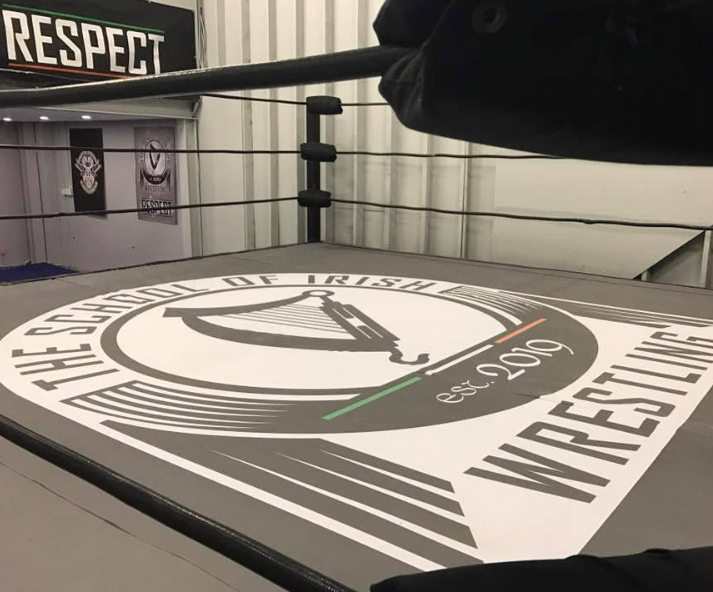
An empty ring at The School of Irish Wrestling illustrates the sightlines a camera position must account for.
Photo: CowboyJW, via Wikimedia Commons. CC BY-SA 4.0; license: https://creativecommons.org/licenses/by-sa/4.0/ . Original image, unchanged.
The first question is where the viewer is meant to be. A ringside position can make the venue feel close, but proximity alone does not guarantee a useful view. Ropes, posts, officials and people moving around the floor can obstruct important moments. A camera position should be judged across a sequence of action, rather than by one attractive still frame.
A raised viewpoint may make the geography of the ring easier to understand. It may also create more distance from facial expressions and small gestures. There is no single position that solves every editorial problem. A production team would need to decide which experience it wants to offer, then test whether the chosen position delivers it consistently.
The photograph accompanying this article shows an empty training ring. Even without an audience or performers, its ropes and corner posts make the sightline question apparent. A test recording in an empty venue would be useful preparation, but the same view would still need testing with normal movement and the people who work around the ring.
A spherical recording allows the audience to choose a viewing direction within the captured scene. It does not automatically let someone walk to the opposite corner or lean around an obstruction. An experience that supports those movements needs a different technical approach and suitable scene information. The description should state what is actually available.
That distinction matters when describing a virtual seat. A seat suggests a particular position, which can be a helpful and honest metaphor for recorded coverage. A promise to explore the entire arena suggests much more. Clear language about viewpoint and movement would help fans understand the product before spending time setting up a headset.
A conventional broadcast can select the relevant camera at a particular moment. In a surrounding view, the spectator may be looking elsewhere. That freedom can reveal an interesting reaction, but it can also mean missing the event that explains it. The production needs a plan for supporting attention without assuming every fan follows the same visual path.
One approach would be to establish the important geography early. Let viewers recognize the ring, entrance and commentary position before a sequence depends on them. Sound and commentary can provide cues when attention should shift. Those cues should help someone understand the scene, rather than constantly instructing them to turn in a new direction.
Replays could serve a distinct role. A clearly introduced replay gives the producer a chance to show a decisive moment from another angle while acknowledging the change in viewpoint. The original sequence and the replay should be easy to distinguish. Confusing the two would weaken the story regardless of how impressive the surrounding image appears.
Switching between viewpoints in a headset can feel different from cutting between rectangles on a television. A viewer who has oriented themselves toward one side of the ring may need to understand a new position after the cut. A producer should test the transition itself, including the direction in which the viewer is initially facing.
Consider a simple rehearsal with two viewpoints and a short action sequence. Ask testers where they think they are after each transition and what they believe just happened. If their answers differ from the intended story, the team has a concrete problem to revise. Adding more cameras would not necessarily fix a transition that already causes confusion.
Crowd atmosphere helps communicate the energy of a wrestling event, while commentary supplies context and continuity. A VR mix should make those roles work together. The audience needs to hear the explanation of a meaningful moment without losing the sense that the event takes place in a shared venue.
YouTube's official spatial-audio documentation distinguishes audio positioned in the surrounding scene from head-locked stereo that stays fixed as a viewer turns. That is a useful technical distinction when planning a mix. It does not prescribe a single correct treatment for commentary, crowd sound or every wrestling production; those choices still require listening tests.
The editing timeline is only one stage of the review. A finished trial should be checked in the intended player and headset, because the delivered experience is what a fan will judge. Verify the selected video format, the opening direction, the visibility of any graphics and whether audio behaves as expected when the viewer turns.
Use a short piece that contains representative challenges: a quiet entrance moment, faster movement, activity near a corner and a transition or replay. Write down the equipment and settings used for the check. If something fails, that record makes it easier to distinguish a production problem from an issue limited to one viewing setup.
Also test the written invitation. A person should be able to understand the experience's format, duration and setup requirements without reading a technical discussion like this one. If access changes or a particular player is required, explain it in the release information. Clear expectations are part of the presentation, not an administrative detail added afterwards.
A worthwhile immersive wrestling broadcast would give fans a meaningful reason to choose that perspective. It might offer a stronger sense of the venue, a sustained view of an unfolding sequence or a different appreciation of ringside reactions. The test is whether those qualities help the audience follow and enjoy the match. The headset is the delivery method; the match remains the reason to watch.
If you enjoy PWInsider.com you can check out the AD-FREE PWInsider Elite section, which features exclusive audio updates, news, our critically acclaimed podcasts, interviews and more by clicking here!











 Bang On Casino