
Want more wrestling news, rumors, and results? Be sure to visit PWInsider.com and PWInsiderXtra.com.

Professional wrestling has always treated television presentation as part of the performance. Entrance videos, name straps and animated match graphics tell an audience how important a wrestler or bout should feel. The production challenge is speed: cards change, creative decisions arrive late and every premium event needs its own visual identity.
Real-time rendering is altering that work. Instead of waiting hours for conventional render farms to produce finished frames, designers can see changes almost immediately inside a game engine. WWE’s graphics team demonstrated its value while preparing Clash in Paris in 2025.
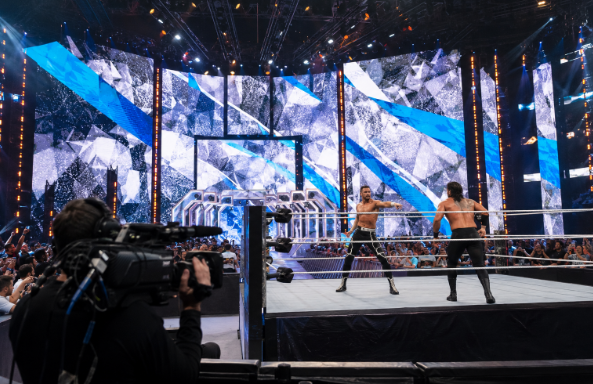
Clash in Paris took place at Paris La Défense Arena on 31 August 2025, followed by Raw at the venue on 1 September. WWE wanted a painterly visual package inspired by Vincent van Gogh, but the schedule left little room for slow revisions.
Lead engineer Perry Harovas told Unreal Engine that WWE runs three live shows every week and at least 36 Premium Live Events each year. Each major event needs a different appearance. For the Paris production, the graphics department had to complete roughly 400 deliverables in two weeks.
Those assets included:
wrestler entrance graphics, name plates and match cards;
arena screens, transitions and animated backgrounds;
promotional versions resized for broadcast and digital channels.
A change to a logo, colour or wrestler’s position can affect numerous files. Traditional rendering turns that correction into a queue. Real-time tools let artists inspect a near-final image while editing it.
That separation between presentation and recorded action also appears in interactive entertainment. At Royal Reels, the interface can display a player’s stake, balance and roulette or slot round in real time, while the casino operator’s server records bet acceptance, the game result and settlement. The animation communicates what happened, but the transaction log remains the authoritative record if a round requires review.
Wrestling broadcasts follow a comparable principle. A graphic explains the current match or storyline, yet it does not control the live action. If an entrance is shortened or a bout is removed, the visual layer must respond without disrupting the programme beneath it.
Visual effects supervisor Cameron Whitehouse was the only member of the Paris team trained in Unreal Engine when the project began. He handled the rendering while 3D art director Cilian Tung and the wider group developed the look.
The team built models of Paris landmarks, including the Eiffel Tower, Notre-Dame and the Louvre. A city environment came from Epic Games’ Fab marketplace. Unreal Engine’s post-processing tools then helped turn those components into the required painted style.
The gains were measurable. In Epic Games’ case study of WWE’s Clash in Paris graphics pipeline, Whitehouse said a 10K image could be rendered in about one hour; an equivalent job had previously taken days. The workflow delivered three advantages:
artists could test bolder concepts before committing;
late corrections no longer meant monitoring a render farm overnight;
one visual language could be adapted across many screen sizes.
The technology did not remove design work. Models, typography, composition and colour still needed human decisions. It reduced the delay between making a decision and seeing whether it worked.
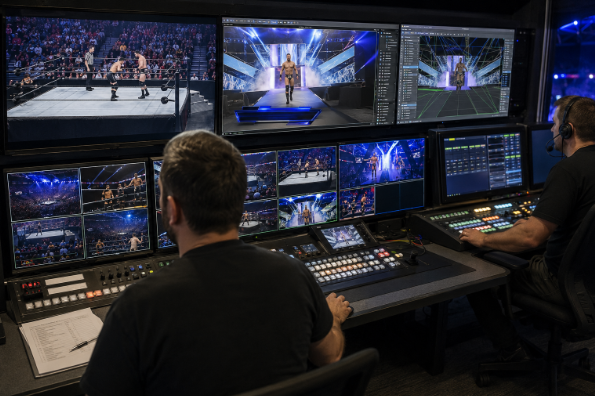
Wrestling graphics are vulnerable to revisions. An injury can remove a performer, a championship may change hands, or a producer may alter the match order shortly before airtime. Even a finished package can need a new name plate or revised championship image.
Real-time rendering makes those corrections less disruptive because the team can update the relevant scene rather than rebuild every frame. It also gives directors more freedom to request variations for arena LEDs, television graphics and promotional clips.
There are limits. A game engine cannot rescue weak art direction, and rushed approval can still put an incorrect name or outdated image on screen. Reliable asset management remains as important as rendering speed.
WWE previously used augmented-reality figures as visible attractions during entrances. Real-time rendering has a quieter role. Its greatest contribution happens backstage, where shorter render times help a travelling television operation deliver event-specific graphics on a relentless schedule.
Clash in Paris showed why the trend matters. Harovas, Tung and White did not simply add another visual effect to the broadcast. Their workflow made hundreds of detailed assets practical under a deadline that would have placed far greater strain on a conventional pipeline.
If you enjoy PWInsider.com you can check out the AD-FREE PWInsider Elite section, which features exclusive audio updates, news, our critically acclaimed podcasts, interviews and more by clicking here!











 Bang On Casino